01
Trace a modeled relationship to exact settlements.
The relationship view and settlement table make the modeled participants, amounts, and dates available for review.
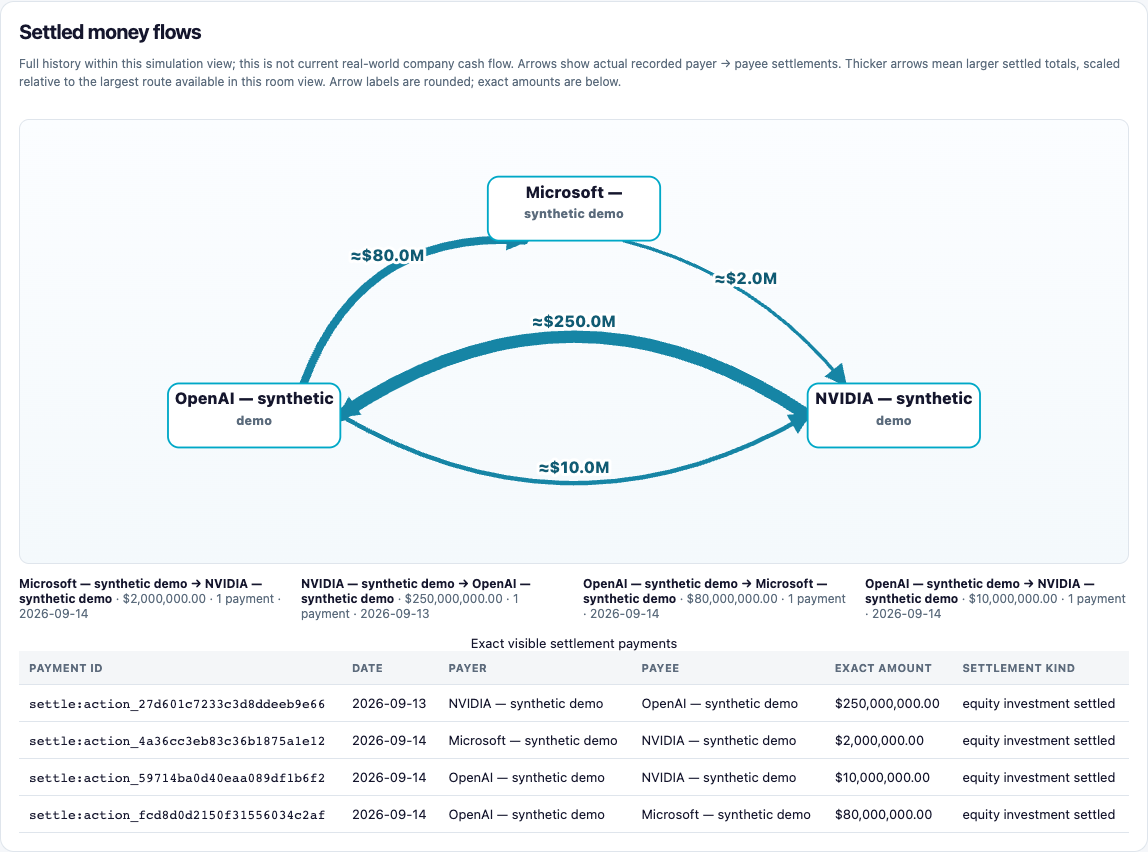 Open full money flows capture
 Industry modeling for private equity
We build executable models of an industry’s major players and their interactions, then test how changes across that system could affect a target company’s revenue, margins, and cash flow.
An industry model. A company in focus.
Relationships, assumptions, and an investment readout.
An industry event. A company consequence.
A competitor adds capacity. Retailers transmit price pressure. Customers shift purchases. Follow those interactions into ConsumerCo’s revenue and margins, then inspect every rule along the way.
ConsumerCo / Capacity expansion
Cash flow would require working capital, capex, tax, and financing. They are outside this demo.
The response adds $0.75M ($1M savings less $0.25M recurring cost); $2.40M of downside remains.
Model boundary: one competitor, aggregated retailers, customers, and suppliers around one target. Fixed category demand and input unit costs; no market feedback, new entrants, capital providers, or infrastructure constraints. Parameters are chosen to expose the logic, not calibrated to an actual industry.
Questions to take back to the evidence
This small example demonstrates explicit propagation, not a predictive industry engine. An engagement would map the major relevant actors, establish evidence for their interactions, and define what remains outside the model.
Existing research model
In our existing AI-industry research model, named participants are connected through modeled commercial and financing relationships. Inspect the industry network, trace synthetic settlements between participants, and distinguish those changes from reference balances.
The relationship view and settlement table make the modeled participants, amounts, and dates available for review.
Open full money flows capture The cash summary distinguishes reference cash from the changes produced within the modeled scenario.
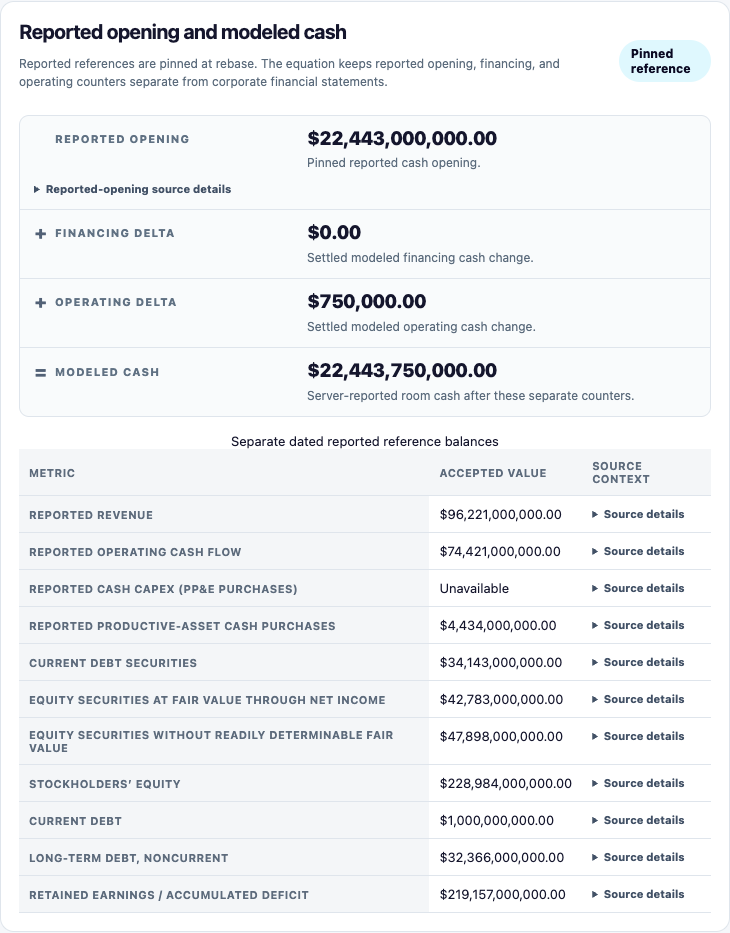 Open full cash summary
 Actual repository UI; synthetic research scenario. Company names identify modeled participants, not clients. These captures demonstrate inspectability, not forecast accuracy or a private-equity customer outcome.
One model. Two consequential decisions.
Test the assumptions behind growth, margins, and cash generation. Identify the evidence that would change your view.
How much pricing pressure can the business absorb before the investment case needs to change?
Translate operating initiatives into assumptions about adoption, implementation cost, and cash savings.
If AI reduces the work required, how much becomes lower spending rather than capacity?
Powered by prompt-driven development
Methodology should be understandable to the people making the decision, with checks that distinguish arithmetic from a claim about the future.
Source, date, units, limits.
Readable and challengeable.
Traceable to the output.
Limits stated beside results.
The engagement
Define the decision, available evidence, and review criteria before scoping the model.
An executable industry model: major relevant participants, their interactions, and the economics of the company in focus.
A reviewable record of inputs, sources, scenario choices, and open questions.
A concise explanation of material sensitivities and evidence that could change the conclusion.